

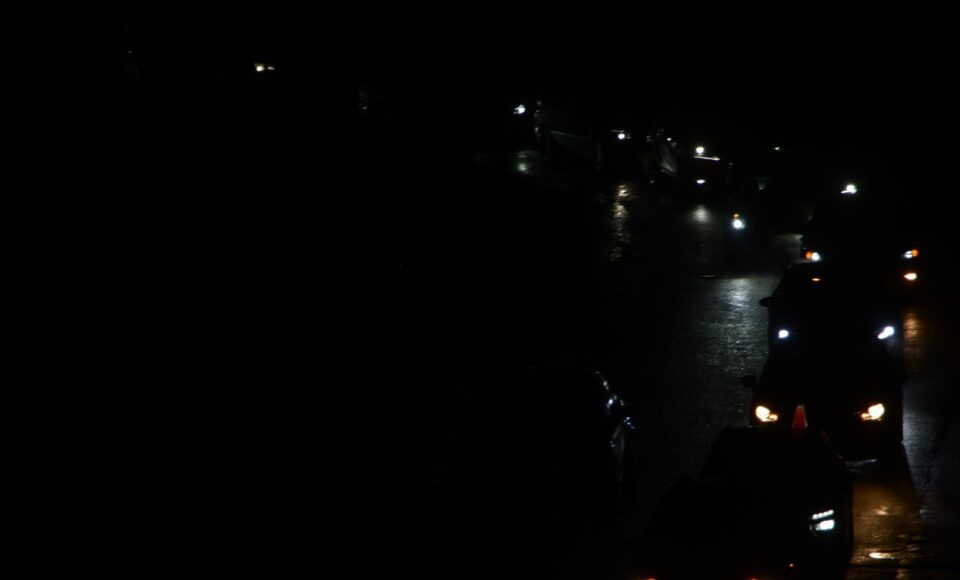

Ukraine has faced serious power outages caused by hostile actions since before Russia’s full-scale invasion in 2022. Since a wave of renewed air strikes affecting energy infrastructure in October, November and December 2025, power outages have become a part of daily life again.
All across Ukraine, electricity is rationed on a stop-start, hourly basis. To manage supply and demand, households are systematically disconnected and reconnected. This deters the worst-case scenarios by assuring supply to critical infrastructure.[1]
However, in some cases the energy companies are unable to deploy emergency control measures. In these cases, neighbourhoods or entire cities are plunged into darkness. Water, telecommunications and heating begin to fail. For example, Odesa has suffered an uncontrolled, continuous power outage of at least five days, after an air strike on the 13th December. Closer to the frontline, many villages have been permanently disconnected for years.
The dynamics of each outage vary depending on its cause, duration, and the capacity to respond. To better understand the complex effects of power outages in Ukraine and support response actors, IMPACT, through the REACH Initiative, recently completed a research project funded by the European Union.
Displaced people face heightened risks
People living in Collective Sites will be particularly affected by power outages. Having fled their homes and support networks, these people face overlapping vulnerabilities. Many are older, live with disabilities, or have caregiving responsibilities that limit their ability to work or access assistance.
Collective Sites are intended as temporary accommodation, but IMPACT monitoring shows many residents stay for years. These sites—often converted schools or dormitories—were never designed for long-term living. Rooms can be cramped and draughty. Outages make conditions even harder to manage.
The health risks are serious: unheated rooms endanger older people and those with chronic conditions. Mobility challenges worsen when elevators or assistive equipment cannot function. Food preparation is affected when refrigerators fail and cookers won’t turn on. Beyond health, outages affect well-being and social life. Common rooms become unusable without light or power, deepening isolation.
IMPACT finds a persistent lack of back-up power in Collective Sites
| Generators make a critical difference, keeping lights on and essential appliances running. Yet, IMPACT’s latest Collective Site Monitoring (November 2025, Round 19) found that 27% of surveyed sites do not have any back-up power source, and 36% anticipate urgently lacking fuel this winter. Generators and fuel are costly, so difficult for vulnerable residents to afford. | 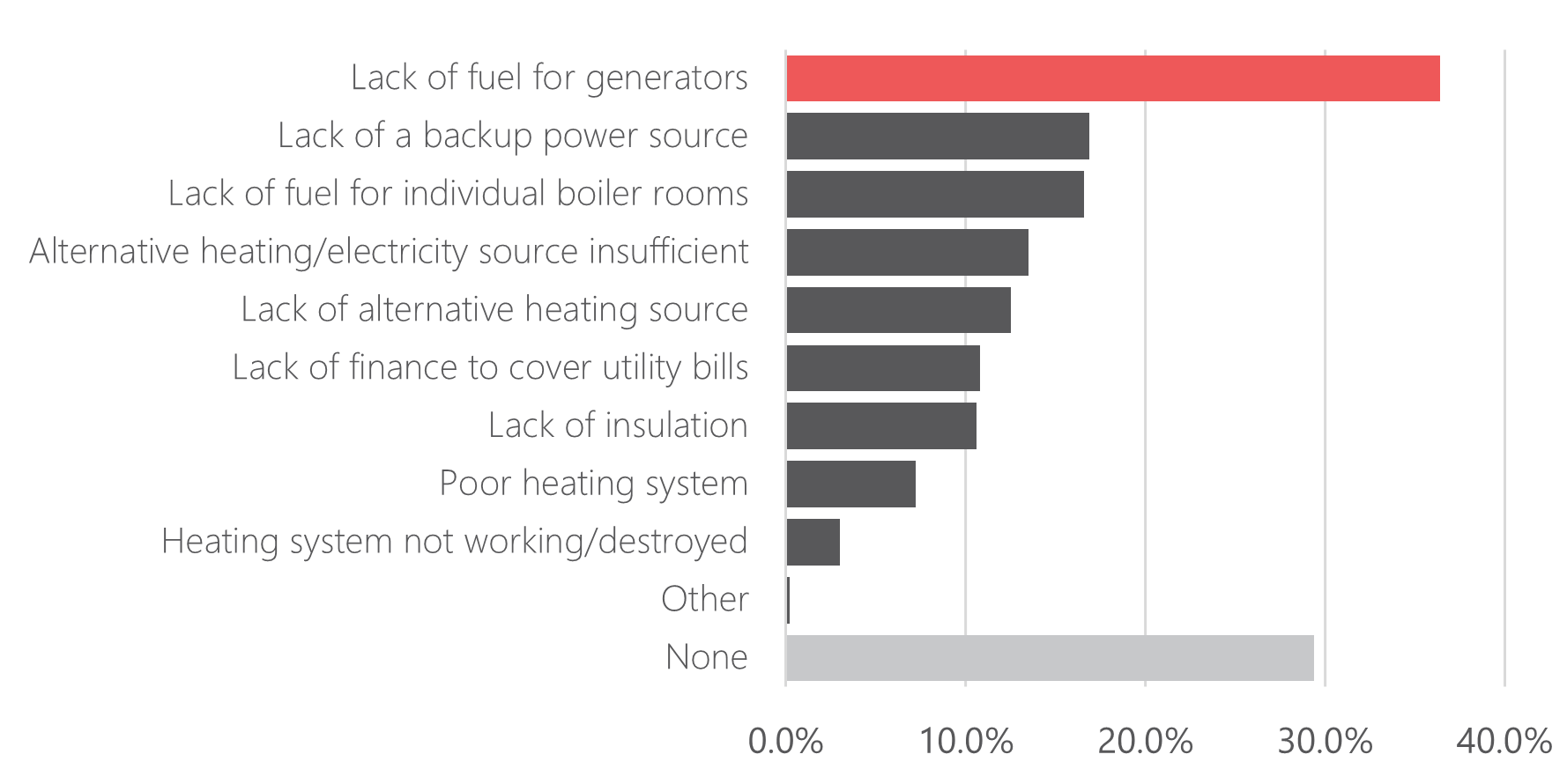 |
| Anticipated most urgent winterisation concerns and needs, by % of collective sites |
| The proportion of collective sites reporting having no generator has stayed the same year to year. More than a quarter of collective sites reported having no alternative power source in November 2025, leaving thousands of displaced people exposed to risks during outages. | 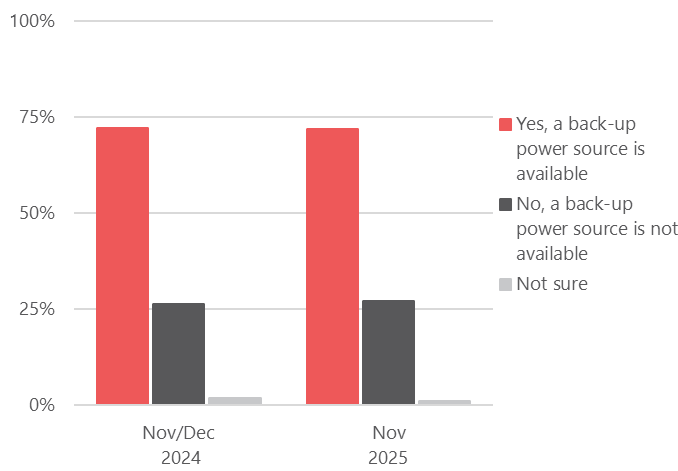 |
% of collective sites reporting the availability of a backup power source |
Resilience and Vulnerabilities
Over time, state agencies, local government workers, emergency services, and the general public have adapted to daily blackouts. Mitigation measures have been put in place, response plans tested, and strategic priorities identified.
However, the lack of backup power continues to pose significant risks for people living in collective sites. Addressing this urgent need would help ensure that vulnerable populations can keep the lights on.
📈 To see the data, visit the CCCM dashboard
🔗 To read more about power outages, read IMPACT Initiatives ’s factsheet (eng/ukr) and report, funded by European Union .
[1] The German Bundestag has published a detailed description of the consequences of a prolonged and wide-ranging power outage. “What happens during a blackout: consequences of a prolonged and wide-ranging power outage”
| Funded by the European Union. Views and opinions expressed are, however, those of the author(s) only and do not necessarily reflect those of the European Union or DG ECHO. Neither the European Union nor the granting authority can be held responsible for them. |  |