


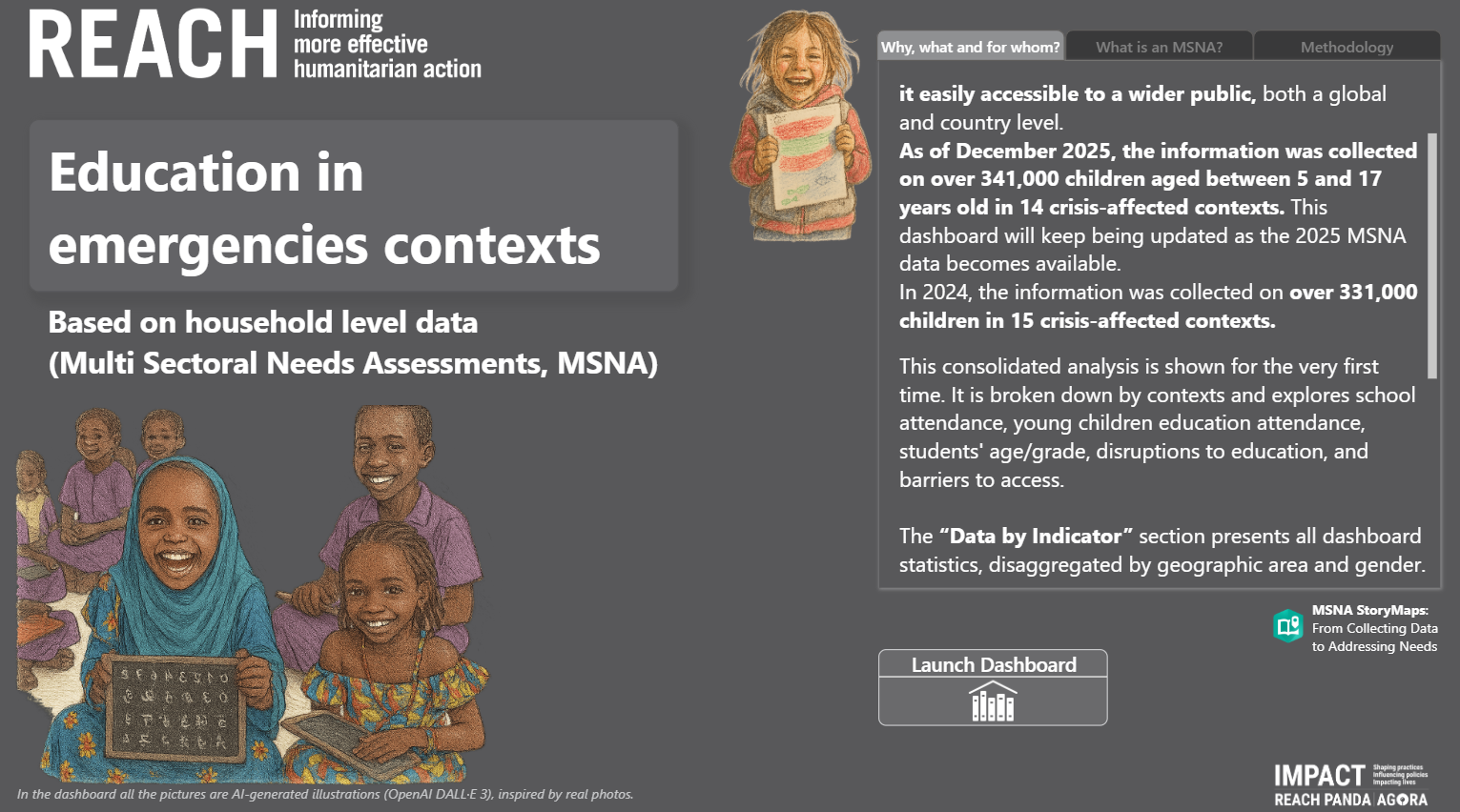
The Education in Emergencies dashboard has been updated with the data collected through households’ surveys (Multi-Sectoral Needs Assessments – MSNAs) in 2025. As of December 2025, the information was collected on over 341,000 children aged between 5 and 17 years old in 14 crisis-affected contexts.[1] This consolidated analysis explores school attendance, access interruption, educational delays and barriers of access to education in 2024 and 2025.[2] It is particularly useful for both global and in-country actors who are looking for granular statistics to inform their prioritization, planning and advocacy in their areas of intervention.
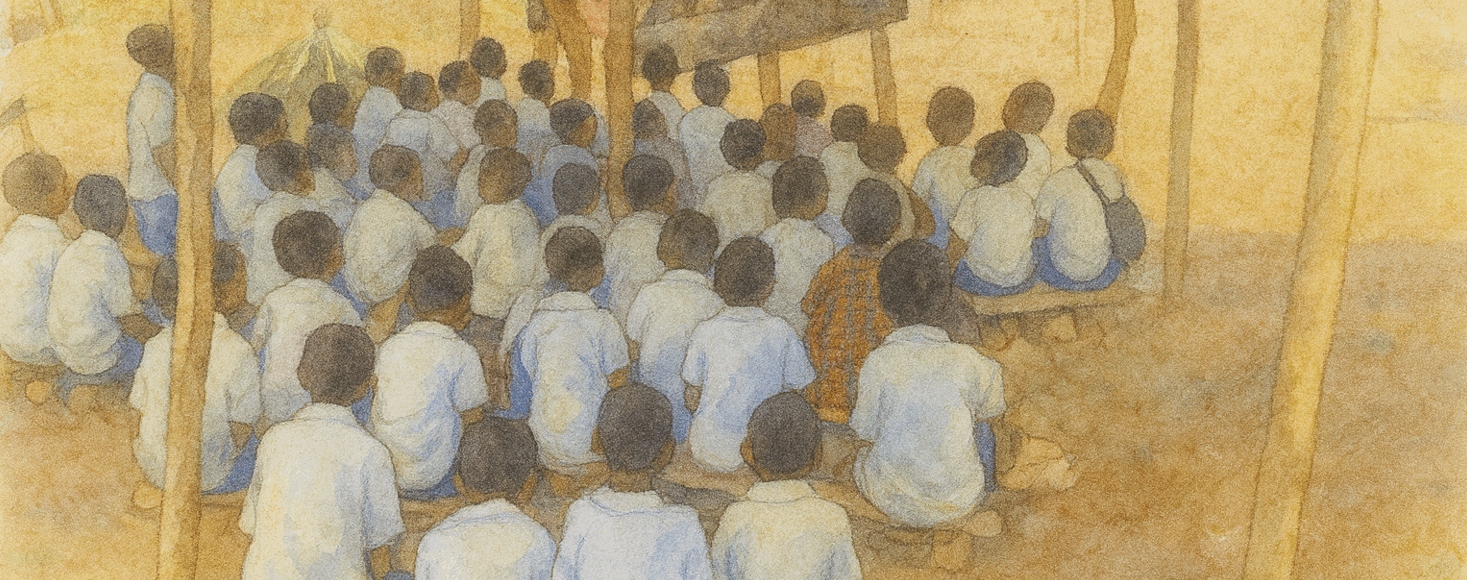
Education needs are fueled globally by a myriad of new, continuing, recurring and often overlapping crises. In 2025, more than one third of the school-aged population residing in the areas covered by the MSNAs were fully denied their right to access education.
In parallel, those who have access to schools continue to encounter barriers to learning. While teachers are essential to upholding children’s right to quality education, they are themselves directly affected and often experience poor working conditions. This leads to demotivation, absenteeism, and destabilization of educational systems. In the 12 contexts studied[3],[4], more than 6.5 million in-school children have seen their education disrupted at some point during the 2024-2025 school year due to teachers’ absence.[5] The multiplication of climate-induced hazards takes an increasingly heavy toll on children with the education of more than one in-school children in four put into jeopardy by natural hazards. In addition, displacement and conflict keep severely endangering the continuity of education: Direct attack on education has disrupted the access to education of more than 2 million children at some point during the year, while 3.4 million have seen their access to school interrupted as these latter were used as a shelter by displaced populations.
Against the backdrop of the funding crisis facing education in emergencies, the 2025 MSNAs’ results show that severe education needs remain in every crisis-affected context. This call for an urgent and collective action among government, development, and humanitarian actors to speed up progress towards achieving the Sustainable Development Goal 4[6], itself a prerequisite for achieving personal and societal development.
Alarmingly, these global figures are underestimated, as some MSNAs in 2025 have been targeted geographically due to funding and/or access restrictions. This means that visibility on the needs of some communities and some regions has purely and simply been lost. For education actors this also leads to a loss of granular data, which are necessary to bring light on how differences in age, gender, legal and disability status affect children educational status, and ultimately provide appropriate interventions.
Children constitute the largest number of affected people in any humanitarian crisis.[7] Out-of-school children are not only deprived to their right to learn but also to their access to other essential services. Investing in schools in emergencies means providing resources to the most efficient structure in delivering needs-based programming for children including access to school feeding and nutrition, water and sanitation facilities, vaccines and other health services, as well as general psychosocial support to manage the trauma experienced in crisis-affected environments.
For any questions or interest, please contact [email protected]
[1] At the time of this dashboard publication, data collection is still ongoing into 2 humanitarian contexts. Additionally, two crisis-affected contexts have been excluded from this publicly available dashboard due to their sensitivity.
[2] As the geographical coverage of most MSNAs has changed in 2025 due to funding and access restrictions, any comparison of results between the two years should be interpreted with extreme caution.
[3] All the figures in this article were calculated based on context-wide OCHA population figures, adjusted to represent the 5 to 17 years old population. The following global statistics do not include the school-aged population who resides in the crisis-affected parts of Kenya and Ethiopia but consider the two additional crisis-affected contexts, whose results are not publicly shared.
[4] These global statistics should not be compared with the ones from the article published on the 3rd of July, which relied on the 2024 results, due to some changes in (a) countries studied, (b) geographical areas covered within these countries, as well as (c) calculation method.
[6] « Ensure inclusive and equitable quality education and promote lifelong learning opportunities for all »
[7] Children make up approximately 58% of people in need, globally.