


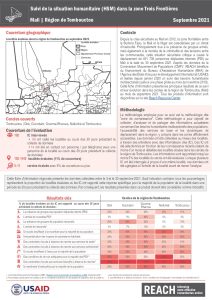
REACH Mali Suivi de la situation humanitaire dans la zone frontalière, Région de Tombouctou, Factsheet (03-30 septembre 2021)
PDF2.2M
| English translation available |
Depuis 2012, l’instabilité politique et le conflit armé ont plongé le Mali dans une crise humanitaire prolongée, marquée par des déplacements massifs, une insécurité alimentaire, une fragilité économique et des chocs climatiques récurrents. En 2026, la recrudescence des violences et le blocus sur l’approvisionnement en carburant imposé par des groupes armés non étatiques continuent de perturber l’accès aux marchés, aux services essentiels et à l’aide humanitaire.
Selon le Plan de besoins et de réponse humanitaires 2026, 5,1 millions de personnes ont besoin d’assistance humanitaire. Le Mali compte plus de 414 000 personnes déplacées internes et accueille plus de 317 000 réfugiés et demandeurs d’asile, principalement originaires du Burkina Faso et du Niger (HCR, août 2026). La MSNA 2025 de REACH souligne également l’ampleur des besoins: 83 % des ménages sont en situation de besoin humanitaire, contre 75 % en 2024, soit une hausse de huit points de pourcentage, principalement liée à l’aggravation des besoins en abris.
IMPACT a déployé son initiative REACH au Mali en 2012, en partenariat avec le Global Shelter Cluster, pour appuyer l’évaluation des besoins et la gestion de l’information. Depuis la reprise de ses activités en 2019, IMPACT produit des données et des analyses pour orienter la planification, la priorisation et l’adaptation de la réponse humanitaire.
Son travail repose notamment sur l’évaluation multisectorielle des besoins (MSNA), menée en collaboration avec les autorités nationales, OCHA et les partenaires humanitaires. Celle-ci permet d’analyser la sévérité des besoins, les disparités géographiques et les vulnérabilités des différents groupes de population. IMPACT contribue également au suivi conjoint des marchés, à la gestion de l’information du mécanisme de réponse rapide (RRM) et à l’analyse des besoins aigus. Ces activités fournissent des éléments complémentaires pour comprendre où intervenir, auprès de quelles populations et selon quelles modalités.
Évaluation multisectorielle des besoins — Bulletin MSNI 2025Novembre 2025 Fondé sur la MSNA 2025, le bulletin de l’indice multisectoriel des besoins (MSNI) présente la sévérité et la répartition des besoins selon les zones et les groupes de population. Il met en évidence les besoins multisectoriels de 83 % des ménages et apporte une base commune pour orienter la planification humanitaire, identifier les populations prioritaires et soutenir les analyses sectorielles. | 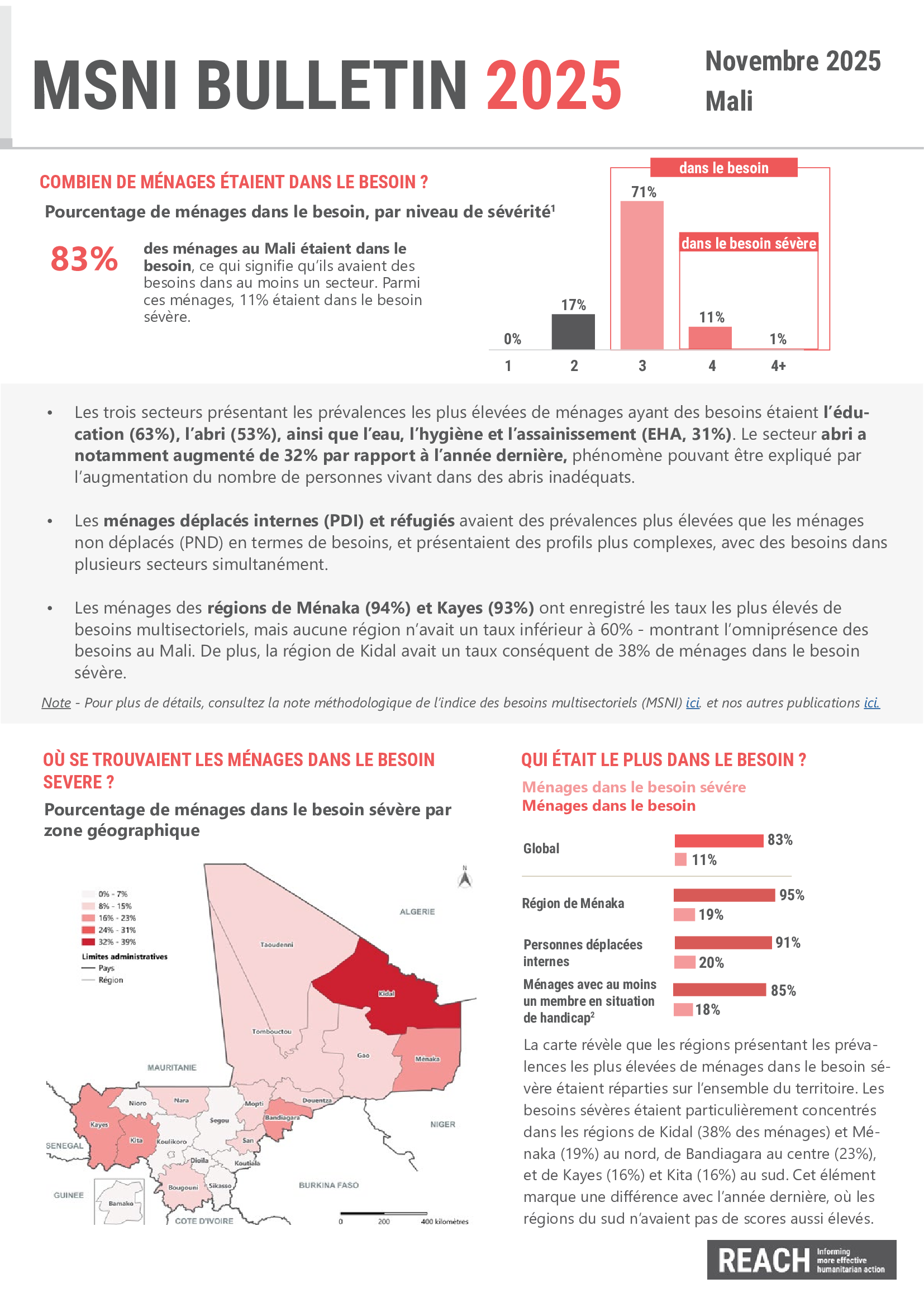 | |
Analyse des Besoins Aigus 2025Juillet – Octobre 2025 L’Analyse des besoins aigus (en anglais Acute Needs Analysis, ANA) 2025 a pour objectif de soutenir la priorisation humanitaire fondée sur les besoins, en identifiant les populations confrontées aux besoins les plus aigus et menaçant leur vie. L’analyse s’appuie sur un cadre standardisé permettant de consolider un large éventail de données et de produire des résultats comparables, tant au sein d’une même crise qu’entre différentes crises. L’ANA se concentre sur les facteurs intersectoriels de mortalité afin d’identifier les zones confrontées à des conditions susceptibles de mettre la vie en danger. | 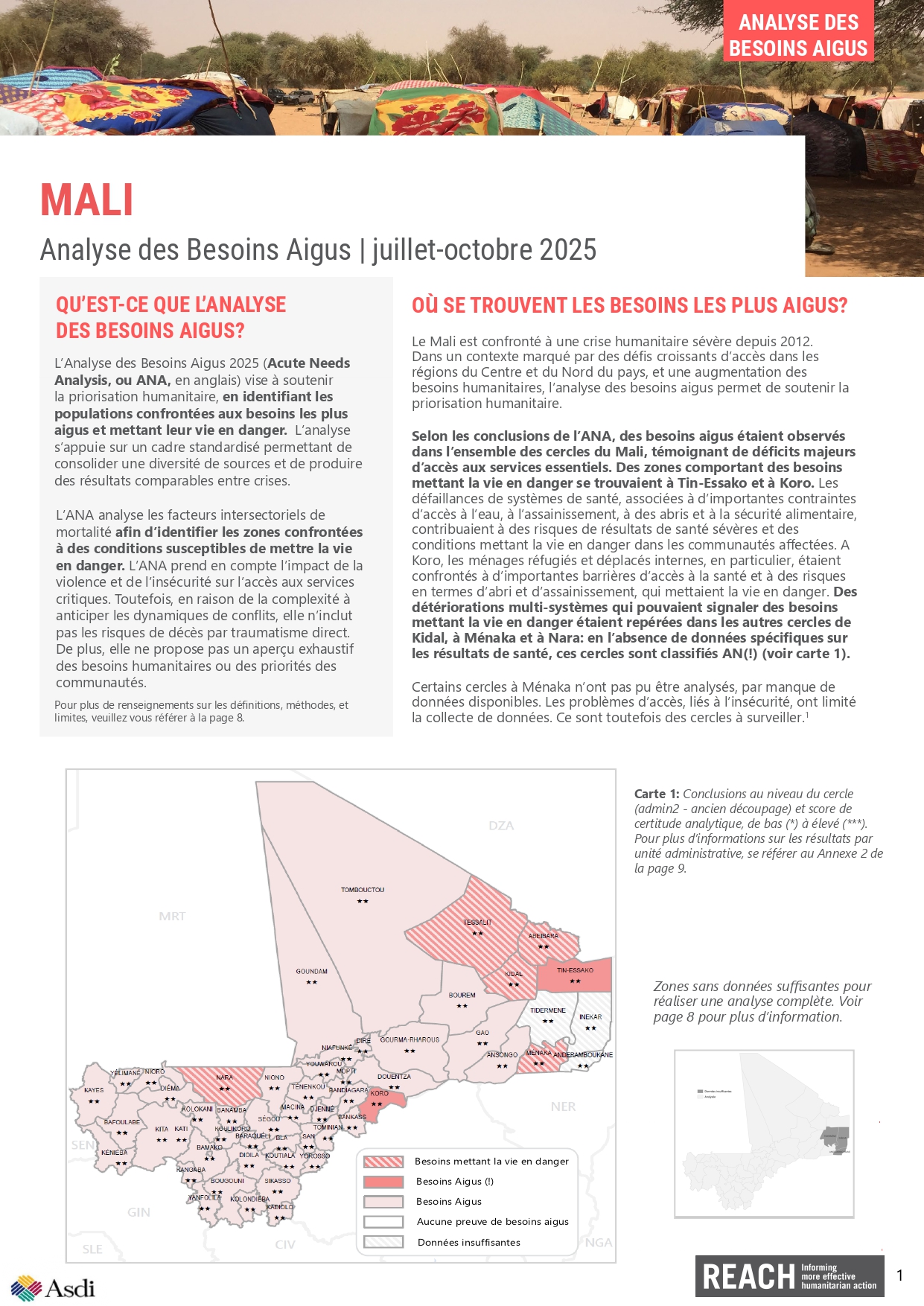 |
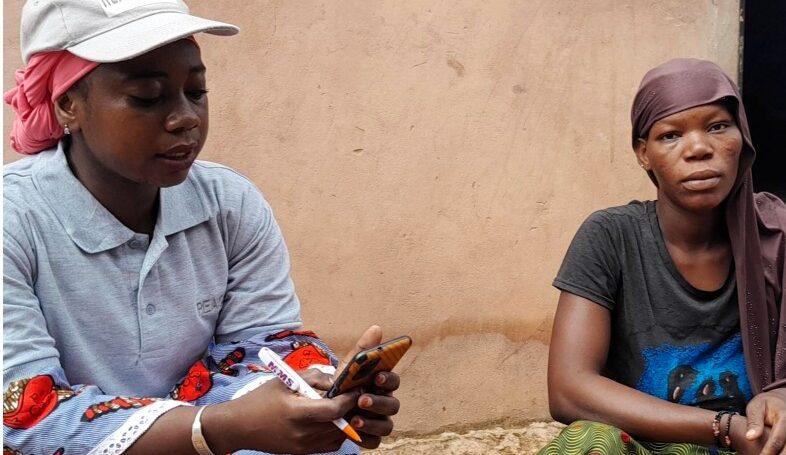
Au Mali, 83% des ménages sont considérés dans le besoin, soit 9% de plus qu’en 2024 au niveau national. C’est le résultat de l’indice multisectoriel des besoins (MSNI) qui s’appuie...

Une récente évaluation réalisée par REACH Initiative, une initiative d’IMPACT, met en lumière des défis sanitaires majeurs dans les régions de Ménaka et Kidal. L’accès limité aux infrastructures de santé...

Le rapport récemment publié sur la perception des besoins et le sentiment d’insécurité à Bandiagara et Ménaka offre des informations essentielles sur les besoins des populations affectées, en particulier...
REACH Mali Suivi de la situation humanitaire dans la zone frontalière, Région de Tombouctou, Factsheet (03-30 septembre 2021)
PDF2.2M
Aperçu de la situation transfrontalière entre le Burkina Faso et le Niger (Septembre 2021)
PDF1.5M
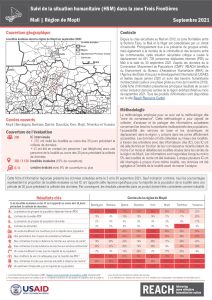
REACH Mali Suivi de la situation humanitaire dans la zone frontalière, Région de Mopti, Factsheet (03-30 septembre 2021)
PDF7.9M
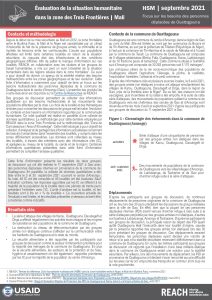
REACH Mali Suivi de la situation humanitaire dans la zone frontalière, Focus sur la commune de Ouattagouna dans la région de Gao, Factsheet (03-30 septembre 2021)
PDF765.2K
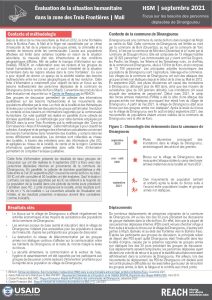
REACH Mali Suivi de la situation humanitaire dans la zone frontalière, Focus sur la commune de Dinangourou dans la région de Mopti, Factsheet (03-30 septembre 2021)
PDF780.1K
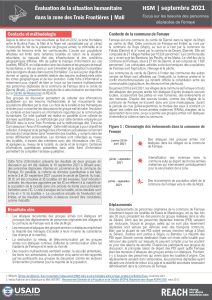
REACH Mali Suivi de la situation humanitaire dans la zone frontalière, Focus sur la commune de Femaye dans la région de Mopti, Factsheet (03-30 septembre 2021)
PDF778.8K
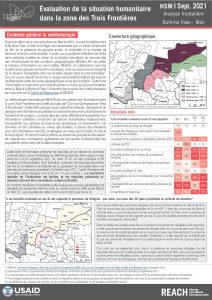
REACH Mali Suivi de la situation humanitaire dans la zone frontalière, Analyse frontalière Burkina Faso - Mali, Factsheet (03-30 septembre 2021)
PDF4.4M

Evaluation de la situation humanitaire dans la zone Trois Frontières, Région de Tillabéri (Niger) Factsheet - Septembre 2021
PDF5.7M
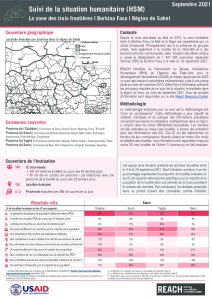
Suivi de la situation humanitaire dans la région du Sahel, Burkina Faso (Septembre 2021)
PDF17.2M
REACH MLI Report Évaluation des besoins en EHA Juillet 2021
PDF1.1M
REACH_Evaluation des besoins en éducation au Mali_Termes de références de recherche MLI JENA ToR External version 23072021 VF (2)
PDF603.3K
Evaluation Multisectorielle des besoins (MSNA), Note méthodologique, Mali – Juillet 2021
PDF878.0K
Evaluation Multisectorielle des besoins (MSNA), Bulletin, Mali – Juillet 2021
PDF2.5M
REACH MSNA 2021 Termes de référence
PDF1.1M
Revue des données secondaires sur l'éducation au Mali - Juin 2021
PDF566.0K
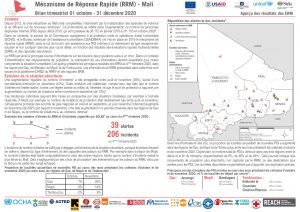
REACH MLI Situation Overview RRM trimestre4 2020
PDF3.5M